 English
 Deutsch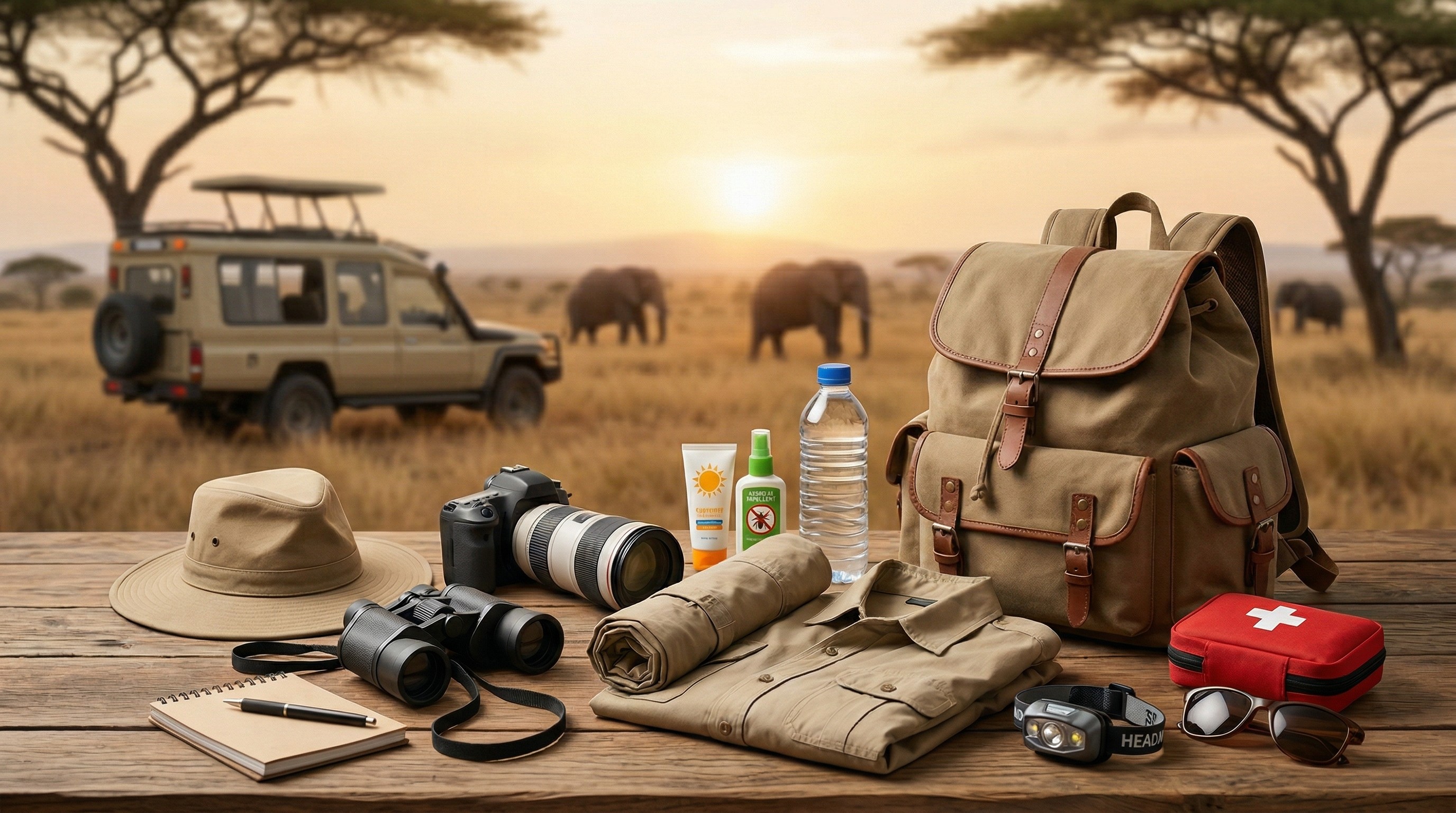
The Ultimate Safari Packing List: What Really Belongs in Your Luggage
Imagine sitting in an open-top vehicle, the sun slowly rising over the savannah, and suddenly a herd of elephants stands just a few meters in front of you… To fully enjoy this magical moment without freezing or searching for sunscreen, proper preparation is everything.
Anyone planning a safari in East or Southern Africa for the first time is inevitably faced with the question: What do I pack? Choosing the right safari clothing and equipment can make the difference between a good trip and an unforgettable one. Whether in the vastness of the Serengeti in Tanzania or the Okavango Delta in Botswana – conditions in nature are diverse.
At Tru Safari, we have put together the ultimate safari packing list for you based on our countless trips to Africa. From classic game drives to adventurous gorilla trekking – here you will find out what really belongs in your travel bag.
Free Safari Packing List as PDFThe Basics: What You Really Need for a Classic Safari (Game Drives)
Whether you are traveling in Kenya, Tanzania, Botswana, or Namibia – there are a few simple, tried-and-tested tips for classic game drives in open or closed vehicles.
First things first: You don’t need to buy a completely new wardrobe for your safari! Comfortable everyday clothes that you already have in your closet are perfectly fine in most cases.
A great tip for your safari luggage is the layering principle: Early mornings and late evenings in the bush can be surprisingly chilly, while it gets quite warm at midday. By wearing several thin layers, you can adapt flexibly at any time.
👒 Clothing & Shoes: Comfort Comes First
- Color choice: Don’t worry, you don’t have to walk around from head to toe in khaki or olive green. Darker red, light blue, grey, or pastel colors are perfectly fine! The only important thing is: Flashy neon colors can look restless in nature (animals react strongly to contrasts), so subtle tones are the better choice. You should also leave black and dark blue in your suitcase, as they attract pesky tsetse flies in some regions (e.g., parts of Tanzania or Botswana).
- Tops: T-shirts are perfect. A thin long-sleeved shirt or a light long-sleeve can be quite practical as an uncomplicated protection against the sun or mosquitoes in the evening.
- Pants: Comfortable long pants (e.g., jeans, chinos, or zip-off pants) and a pair of short shorts for the warm afternoon are ideal.
- For the cool hours: A warm sweater or fleece jacket, as well as a light, wind-resistant jacket for the morning breeze during the drive.
- Shoes: The main thing is they are comfortable! Since you’re mostly sitting in the safari vehicle during classic game drives, normal sneakers or casual shoes are perfectly adequate. You can safely leave heavy hiking boots at home for a normal game drive.
- Headgear & Co.: A normal cap or sun hat protects you from the sun. Sunglasses are not a must, but very pleasant on bright days and when dust is kicked up on the tracks.
🧴 Equipment & First Aid Kit: Little Helpers
- Soft travel bag: When it comes to your luggage, we recommend a soft travel bag or a backpack. They can be stored flexibly in the trunk of the safari vehicles and handle the bumpy dirt roads much better than a hard-shell suitcase. If your route also includes a flight with a small bush plane, soft bags are the best choice anyway due to the limited storage space.
- Reusable water bottle: Although you get small plastic bottles of water in many safari vehicles, the trend is moving strongly towards sustainability for the sake of nature. Many lodges now offer clean drinking water dispensers with filtered water.
- Binoculars: An absolute highlight on every safari! They allow you to see details on animals that are further away. Don’t have your own binoculars? No problem! Just let us know when booking – we’ll be happy to organize one for you on request.
- Power adapter: Don’t forget the right plug adapter for your travel destination. A standard universal adapter is often not enough, as some African countries have very specific sockets.
- Typ M: South Africa, Namibia, and often also Botswana.
- Typ G: Kenya, Tanzania, Uganda, Zimbabwe, Zambia, and partially Botswana.
- Typ C: In Angola, Madagascar, Rwanda, and Zambia, you can often get by with a European or Swiss plug.
- Insider tip: Take a power strip from home! That way you only need a single adapter on-site, but can charge your camera, phone, and power bank simultaneously overnight.
- Mosquito spray & sunscreen: A good insect repellent and sufficient sunscreen belong in every safari bag.
- Personal first aid kit: Pack a small bag with the most important basics. Important: Depending on the region, malaria prophylaxis may be useful – be sure to clarify this beforehand with your doctor or a tropical institute.
- Gastrointestinal: Remedies for complaints (e.g., Imodium, charcoal tablets)
- Pain & Fever: Ibuprofen or Paracetamol
- First Aid: Band-aids and a disinfectant spray for small scratches
- Skin care: A soothing ointment for insect bites
- Personal: Of course, your personal medication in sufficient quantity
📑 Documents & Finances:
- Documents & Insurance: Your passport (usually valid for 6 months beyond the trip) and, if applicable, your vaccination certificate (e.g., for yellow fever) are mandatory. Also, keep digital copies of your documents on your phone or in a cloud. Good travel health and trip cancellation insurance is also important for Africa.
- Finances: Take enough US dollars in small bills for tips; this is welcome everywhere.
- The pen trick: Pack your own pen in your carry-on luggage! Upon arrival at the airport, you often have to fill out entry or visa forms, and pens are often in short supply there.
Additional Equipment
🌿 What You Need for a Walking Safari
If you decide to explore the African nature on foot during a bush walk (walking safari), the perspective changes completely. You are now right in the middle of it instead of just being a bystander. Here, the right equipment is safety-relevant.
- Now the safari colors come into play: While you can easily wear light blue or dark red in the car, it’s not a good idea on foot. Animals see contrasts very well. To avoid being perceived as a foreign object or even a threat, you should opt for subtle natural tones on a walking safari. Khaki, olive green, beige, or earth tones are the first choice here.
- Sturdy, closed footwear: Comfortable, broken-in, and ankle-high hiking boots are very important on bush walks. They give you stability on uneven terrain and protect your ankles from thorny bushes, insects, and scratchy grass.
- Long pants: Even if it’s warm – long, lightweight pants protect your legs from tall grass, ticks, and scratches. Zip-off pants are particularly practical for this!
- Small daypack: Perfect for carrying a bottle of water, your sunscreen, a camera, and maybe small binoculars comfortably on your back.
- Breathable socks: Good hiking socks prevent you from getting blisters during the walks in the heat.
🚤 Boat and Mokoro Safari
Whether you’re gliding through the Okavango Delta in a traditional dugout canoe (Mokoro) or doing a boat safari on the Kazinga Channel in Uganda – a few small details are quite practical on the water:
- Extra sun protection: The water strongly reflects the African sun. Sufficient sunscreen, a sun hat, and sunglasses are highly recommended on the boat.
- Shoes: You can easily keep your sneakers on! When getting in and out of the small Mokoros on the shore, it can sometimes get a bit wet – here, water-friendly sandals are a sensible addition.
- Waterproof dry bag: Not a must-have at all, but if you want to be on the safe side, a small dry bag will protect your camera from unexpected spray on the flat canoes.
🦍 Gorilla Trekking in Uganda & Rwanda
Gorilla trekking in the mountain forests of East Africa is a rugged, beautiful adventure. You are often off the beaten track, the ground is damp, and the undergrowth can be dense. When it comes to your packing list, it’s all about one thing: protection and comfort in the jungle. By the way: We are happy to plan your individual gorilla trekking for you!
- Waterproof, ankle-high mountain boots: Since the ground in the rainforest is often slippery and muddy, shoes with good tread are worth their weight in gold. The ankle-high cut also gives you stability on steep slopes.
- Gardening gloves: Yes, you read that right! A simple pair of gardening gloves from the hardware store is an absolute insider tip. During the ascent and descent in the dense forest, you often have to hold onto branches – and those in the rainforest can have thorns or sting like nettles.
- Gaiters: Not a must, but they reliably keep deep mud, wetness, and scratchy undergrowth away from your shoes.
- Long pants and long-sleeved shirts: Shorts are absolutely taboo during gorilla trekking. Light but tear-resistant long pants and a long-sleeved top protect your skin from scratches from branches and from insects.
- The absolute fashion tip: Tuck your pant legs deep into your socks! This might look a bit funny in photos, but it’s the guides’ most proven trick to prevent red ants from crawling up your legs.
- Waterproof rain jacket or a poncho: We are in the rainforest – a sudden rain shower is completely normal here. A light poncho or a good rain jacket therefore belongs in your small daypack.
- Daypack: Here you store your water, your packed lunch, the rain jacket, and of course your camera.
🚙 Packing List for Your Self-Drive Safari (Rental Car & Roof Tent)
If you explore Southern Africa on your own in a four-wheel-drive vehicle, you are completely flexible. However, since you often spend the night on lonely campsites and drive long distances yourself, there are a few helpers that make life in the bush much easier:
- Headlamp: An absolute must-have for camping! When you’re standing at the grill fire in the evening, looking for something in the trunk in the dark, or climbing the ladder to the roof tent, you’re incredibly glad to have both hands free.
- Offline maps & navigation: You don’t always have cell service in the middle of the Namibian desert or in the national parks. Download navigation apps (such as Tracks4Africa or offline maps from Google Maps) at home.
- Power on the go (Power bank & adapter): There is no power connection at many nature-oriented campsites. A USB car charging cable for the cigarette lighter and a good power bank are particularly important so that phone and camera batteries are always ready for the next animal motif.
- International driver’s license & documents: Don’t forget to pack your international driver’s license along with your national one. These documents are mandatory for rental car trips in Africa. It’s best to make copies of all important documents on your phone beforehand.
- Camping equipment & sleeping bag: Don’t worry, you don’t have to squeeze half an outdoor store into your travel bag! When you rent a 4x4 camper, the complete equipment (roof tent, mattress, sleeping bags or bedding, pillows, and cooking utensils) is already on board. Our insider tip: A thin silk sleeping bag (liner) takes up very little space in your luggage but is very pleasant – be it for hygienic reasons in the rented sleeping bag or on very warm nights when the thick sleeping bag is simply too hot.
Your Safari Packing List to Check Off
You now know exactly why certain things belong in your safari luggage and which details you should pay attention to for your specific type of travel. But we also know: When you’re standing in front of your open suitcase shortly before departure, you don’t want to read long blog posts anymore. You just want to pack!
That’s exactly why we’ve put together our detailed and comprehensive safari packing list as a clear PDF for you. In it, you’ll find everything that needs to go with you – from practical zip-off pants to the right power adapter to the absolute basics like toothpaste, underwear, and travel documents. Simply print it out, check it off, and start your vacation completely relaxed!
Download your Safari Packing List now!Ready for Your African Adventure?
Proper preparation is half the success. If you consider the basics for your region and travel style and have printed our PDF, you can concentrate fully on the breathtaking wildlife on-site.
Do you have any questions about your packing list or are you looking for the perfect route for your next trip to Africa? We at Tru Safari will be happy to advise you personally!